Clearing Branches From Utilitiy Lines

I thought I’d share a couple of photos from a job I completed last week. Three large beautiful Deodar Cedars (Cedrus deodara) were growing in a backyard in the Wedgewood neighborhood of Seattle. The only problem was the six utility lines running through the trees to a couple of houses. The homeowners were worried about snow load and windstorms knocking branches into the lines.
Before pruning: branches from the Deador Cedar close to and resting on wires.

Before pruning: branches from the Deador Cedar Cedrus deodara close to and resting on wires.

After about 3 hours of pruning and maneuvering around up in the trees, the lines were no longer in contact with the tree and there was plenty of clearance around the branches that remained. A potential future power outage averted!
After several hours of climbing, and assistance from the ground crew below, the wires are running through the Cedrus deodara unimpeded to the house.

After several hours of climbing, and assistance from the ground crew below, the wires are running through the Cedrus deodara unimpeded to the house.

                    Notice I left several branches lower on the trunk that are below the level of the wires. Low branches are important to tree health, especially in older trees. Branches help stimulate the tree to increase trunk width and strength in the areas where they are attached.
Posted in Tree Care | Leave a comment

Leaf Miners

Leaf Miners tunnel between layers within a leaf, eating the plant tissue and often leaving a very distinctive trail through the leaf or patches of dead brown leaf tissue. These sometimes strange looking markings on leaves are caused by the larva of a variety of insects; from sawflies, to months, and other types of flies.
Very obvious tunneling damage to a Madrona (Arbutus menziesii) leaf.  Notice how the width of the tunneling gets wider as the larva grows.  The black spots are a fungal blight and not related to the Leaf Miners.

Very obvious tunneling damage to a Madrona (Arbutus menziesii) leaf. Notice how the width of the tunneling gets wider as the larva grows. The black spots are a fungal blight and not related to the Leaf Miners.

If you’ve spent much time in your garden or even just out in the forests or parks, you may have seen their damage to leaves and sometimes even fruit. After eggs are laid on the leaf, larvae hatch and eat their way through the leaf, growing larger as they tunnel. After their required amount of time, which varies by species, the larva or “worm” emerges and usually falls to the soil below to pupate and later emerge as an adult. A very common Leaf Miner in Seattle gardens is the beet or spinach Leaf miner. It’s often seen on chard, beet and spinach leaves and can become so prevalent that the crop is ruined. Specific information on this pest can be found here.  
Some Leaf Miner tunnels on a weed.

Some Leaf Miner tunnels on a weed of the mint family.

Methods of control for all species of leaf miner vary from physical removal of infected leaves, to specific insecticidal sprays. Sprays are often not very effective though, because the larvae are protected within the layers of leaf tissue.
Posted in Gardens, Landscapes, Tree Care | Leave a comment

Grafting Fruit Trees

Grafting season is just coming to a close, but I wanted to take this opportunity to explain why and how grafting is done, and show a few photos from some apple trees I grafted last Tuesday in North Seattle.
Whip-and-tongue graft completed.

Whip-and-tongue graft completed.

Every specific variety of apple, orange, plum, cherry, grape, kiwi, etc. that you eat is genetically identical to the other of the same name. These fruits are not grown from seed, but instead are grafted onto another tree or “rootstock”. One of the reasons this is done is that there is a lot of genetic diversity in many fruit seeds, so you’re not likely (in fact almost guaranteed not to in the case of apples) to get an entirely different fruit if you planted a seed. Although in some fruits, for example stone fruits (plums, peaches) there is less variation from seed so planting these pits may actually give you a relatively similar fruit. Some specific varieties of fruits such as oranges or grapes have been bred to be seedless, so grafting is the only way to propagate these types.
A rough example of what a whip-and-tongue or whip graft looks like.  I cut this quickly just to illustrate the general look.  Actual grafting cuts would fit tighter.

A rough example of what a whip-and-tongue or whip graft looks like. I cut this quickly just to illustrate the general look. Actual grafting cuts would fit tighter.

Grafting consists of connecting the tissue of one plant onto another so that they grow together. I’ve had the most success using the whip-and-tongue or whip graft. A piece of scion wood (the wood from the desirable plant) is cut in a certain way and fitted onto the rootstock or the branch of an existing tree. The graft is wrapped in special tape and the ends are sealed with wax or tar to retain moisture. After several weeks the graft should have grown together and the buds on the scion wood will begin to grow. With this method it’s possible to have many varieties of fruit on one tree.  There are many advantages to this such as proper pollination, or to lengthen the season over which the fruit ripens.  For example you could have five different varieties of apples on one tree.  A Williams Pride which ripens in August, followed by an Akane, Pink Lady, Honeycrisp, and finishing off the season with a Braeburn which ripens mid to late October.
A completed whip-and-tongue graft (on the left) on a young apple tree in Seattle.

A completed whip-and-tongue graft on a young apple tree in Seattle.

Another type of grafting called budding can be done in mid summer. This involves taking a bud from a desirable tree and slipping it into the bark of a branch or another tree after making specific cuts into the bark. So if you’ve missed this grafting season, you can still add another variety to your fruit tree this summer. The Seattle Tree Fruit Society has a nice web page with useful links if you’re interested in learning more about grafting.  
This is a whip and tongue graft approximately one year after the grafting took place. An heirloom Roxbury Russet apple grafted onto a native Pacific Crabapple. The native crabapples are great pollinator trees and tolerate wet soils, making it a good choice for a rootstock in some places in the Pacific Northwest.

This is a whip and tongue graft approximately one year after the grafting took place. An heirloom Roxbury Russet apple grafted onto a native Pacific Crabapple. The native crabapples are great pollinator trees and tolerate wet soils, making it a good choice for a rootstock in some places in the Pacific Northwest.

Posted in Fruit Trees, Tree Care | 4 Comments

Birch Syrup

I thought I’d share this clip I filmed about a month ago, a birch tree I was pruning East of Seattle. Notice the sap dripping from this freshly cut branch.   It’s a fairly complex process that causes the sap to begin to flow in the spring. Simply put, as the tree is coming out of dormancy in the late winter and early spring water and sugars (sap) stored in the roots begin to move up the trunk to feed new leaves and buds as they emerge. This is the time of year that Sugar Maples (Acer saccharum) are tapped in the Northeast U.S. where the majority of maple syrup in this country is produced.   The sugar content of Sugar Maple sap varies between 2 and 5%, whereas birch sap is about 0.5-2%. The sap from a number of species of maple trees can be used to make syrup, as well as a few other species such as birch. In fact a quick online search yields several websites that sell birch syrup. I collected a small cup of this sap, it had good flavor and was ever so slightly sweet. If you’re interested in harvesting the sap from your trees, small kits are available online. Our native Bigleaf Maple (Acer macrophyllum) might be a good candidate.   The tapping of trees to harvest the sap or cutting of branches which causes bleeding, hasn’t been known to cause any long term damage. The tree won’t “bleed out” or be killed by losing too much sap.
Posted in Tree Care | Leave a comment

Reasons to Mulch… Morels!

Adding mulch around young trees and in landscaped areas is one of the easiest and most beneficial things you can do for your plants. You may also get an edible surprise in the spring or fall. I found these Morels yesterday in Seattle in a landscape where I had applied some purchased mulch last winter.
Most likely a Black Morel (Morchella elata) growing in mulch in a landscaped yard.

Most likely a Black Morel (Morchella elata) growing in mulch in a landscaped yard.

While these Morels were growing in mulch purchased from a landscape supply place, I’ve also seen them growing in “Arborist chips” which are chipped up branches and limbs from tree removal companies. These wood chips are my favorite as they have many benefits: they moderate soil temperatures, hold moisture, help prevent weeds, and they slowly break down and release nutrients- best of all they can be free. Many large tree removal companies maintain a list of people interested in receiving a load of wood chips, just call and get on their list. These wood chips are better than “beauty” bark in that they break down quicker (thus building soil and adding nutrients) and are not overly acidic or hydrophobic as Douglas Fir (the most commonly used species) bark can be. I’ve seen beautiful black soil filled with worms at the bottom of a woodchip pile that was a few years old. There was a rumor spreading several years ago that putting wood chips on soil “stole” nitrogen from the underlying soil. This is untrue. Only if you mix the wood chips into the soil can this occur. So get out there and mulch your perennial garden beds and around your trees, who knows what might spring up!
A sampling of what I collected.  Note the penny for size reference.

A sampling of what I collected. Note the penny for size reference.

Posted in Fungi, Landscapes | Leave a comment

Sapsucker Damage to Trees

These are relatively recent feeding sites from a Sapsucker woodpecker.

These are relatively recent feeding sites from a Sapsucker woodpecker.

While out in the forest, park, or even your own backyard you may have seen rows of small holes seemingly drilled into the bark of trees. These holes are not from an insect (those are more randomly spaced and usually smaller) but from a type of woodpecker called a Sapsucker (Sphyrapicus sp.). They chip away the outer layer of bark to feed on the tree’s sap. They usually prefer thinner barked trees such as birch, but can be found on conifers as well.
Repeated damage by sapsucker woodpeckers over the previous few years.
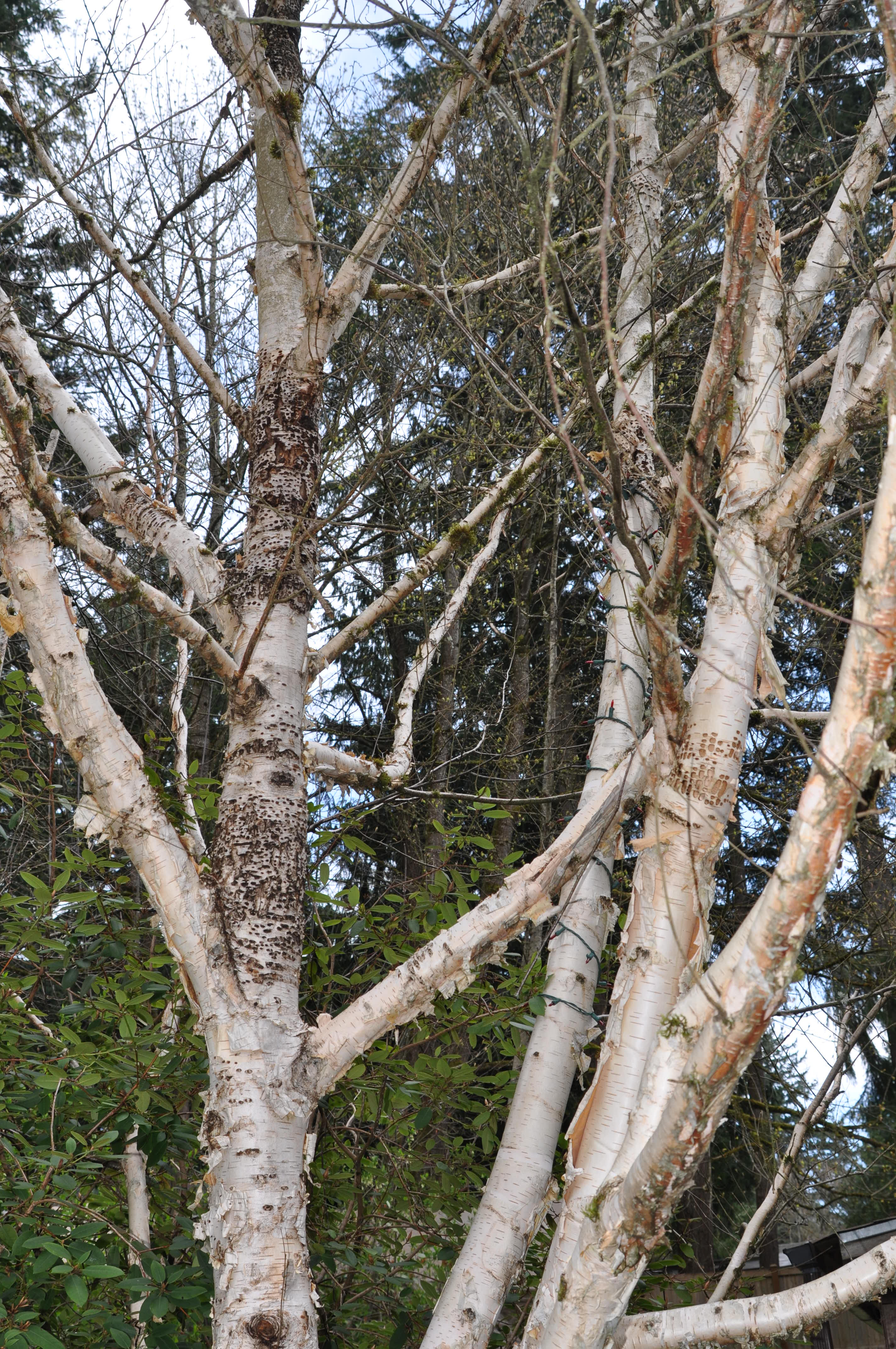
Repeated damage by sapsucker woodpeckers over the previous few years.

Damage is usually not severe enough to cause significant long term damage to the tree. Although the Birch tree I was pruning east of Seattle and is pictured here, seemed to suffer enough damage that its growth habit was altered. Instead of one central leader, lower more vertical branches began to assume dominance because of the extensive damage to the leader, giving the tree a multi-trunked vase shape.
The main stem of this birch tree has been repeatedly fed on by sapsuckers.

The main stem of this birch tree has been repeatedly fed on by sapsuckers.

Since it’s most often not very damaging to the tree, control is not necessary. If you feel it’s causing significant damage or just find it unsettling to see holes in your favorite tree, wrapping burlap loosely around the area or hanging brightly colored tape may discourage the sapsuckers from returning.
An example of Sapsucker feeding on a holly tree.  The missing bark is probably due to a combination of factors and not solely from the sapsuckers.

An example of Sapsucker feeding on a holly tree. The missing bark is probably due to a combination of factors and not solely from the sapsuckers.

More information
Posted in Tree Care | 1 Comment

Tent Caterpillars

Those few sunny warm days we had last week must have queued the hatching of these tent caterpillars. I spotted a few groups just emerging from their eggs on an apple tree I was pruning in the Skagit Valley, near Mount Vernon. I’m sure they’ve emerged in Seattle as well, as it’s almost a climate zone warmer there.
Tent caterpillars just emerging from eggs on an apple twig (the branch is about pinky finger diameter).  They are just begging to spin a silken mat for protection.

Tent caterpillars just emerging from eggs on an apple twig (the branch is about pinky finger diameter). They are just beginning to spin a silken mat for protection.

Tent caterpillars (Malacosoma sp.) feed on Rosaceae family plants (apple, plum, cherry, crabapple, etc.) as well as several other trees such as alder, ash, and willow. They are most noticeable in the late spring and early summer. By this time they’re full grown at about 2 inches and have spun extensive silken webs for shelter and protection from predators. They mainly feed at night and rest in their webs during the day. Large outbreaks can sometimes defoliate entire trees, or in extreme cases sections of forest, but usually don’t cause lasting damage or die-back unless the tree is stressed for other reasons or infested for multiple seasons.
Young tent caterpillars on an apple blossom.

Young tent caterpillars on an apple blossom.

    For control it’s most effective to pick out the gray foamy looking egg masses starting late summer to late spring, although this can be unpractical on large trees. I’ve only seen them on pencil to finger width diameter branches, but they can also be laid on the trunk and in bark crevices. Later in the spring when the silk nests are more obvious they can be stripped out or pruned out and destroyed. There are a number of predator insects that will feed on or parasitize tent caterpillars, so any broad spectrum insecticides should not be used.
A strategically placed tent caterpillar egg case which was laid at the base of an apple tree fruiting spur last summer.

A strategically placed tent caterpillar egg case which was laid at the base of a fruiting spur last summer.

A mature tent caterpillar that has been eating a young apple leaf.

A mature tent caterpillar that has been eating a young apple leaf. (photo by Jeremy Harrison-Smith)

Posted in Tree Care | Leave a comment

Holly Bud Moth

I was in Carnation WA at Camp Korey last week taking a look at their trees and came across several very sick Holly trees. There were several things going on with them including some severe Sapsucker damage (I’ll discuss that in a future post) which very likely made them more susceptible to other pests. The damage pictured here appears to be leaf chewing from the larva of the Holly Bud Moth (Rhopobota naevana).
Damaged leaves

Holly Bud Moth Damaged leaves

Unfortunately Holly (Ilex) isn’t the only plant this moth will feed on. It can also cause damage on Blueberry, Apple, Cherry and Cranberry, among others. It’s not apparent from the research I’ve seen how readily it spreads between plant species, but this may be another reason to get rid of any English Holly trees that are a home to this pest. It is on the “monitor list” of the Washington State Weed Control Board after all. Here is more information on Holly Bud Moth.        
Damage to last year's new growth from Holly Bud Moth

Damage to last year’s new growth from Holly Bud Moth

Posted in Tree Care | Leave a comment

Pine Tree Pest

I was pruning a Pine tree last week and came across this guy:


Sequoia Pitch Moth Larva It’s a called a Sequoia Pitch Moth – Synanthedon sequoiae. The larvae feed on the cambium (living tissue) part of the tree trunk and branches. It’s usually not a problem for trees that are otherwise healthy. The moth larvae is mainly an aesthetic pest, causing infected trees (Pines, Douglas Firs, and Spruces) to bleed sap where the larvae are feeding, resulting in masses of pitch that are exuded by the tree. If you’re worried about it becoming a problem, remove the masses of pitch and associated larva by hand and limit pruning to October through March which is when egg laying females are inactive. The females are attracted to and lay eggs near injury sites, so make proper pruning cuts that will heal over. For more information see UC Davis The fate of the larva pictured? A snack for my chickens!


The larval stage of the moth and the mass of pitch it caused the tree to exude.

The larval stage of the moth and the mass of pitch it caused the tree to exude.

Posted in Tree Care | Leave a comment

Soil Testing

Garden SoilBefore you put the first veggies in your garden this spring, it might be a good idea to get your soil tested- especially if you’re starting a new bed or bringing in a lot of new soil of unknown origin. A basic soil analysis can tell you what macro and micro nutrients are available to your plants, soil PH, and organic matter levels- among other things.


If you’re a resident of King County WA you can get a basic soil test for free from the King Conservation District. The test from University of Massachusetts Amherst is more comprehensive in that it tests lead and aluminum levels. Cost: $10


Remember to get those indoor seedlings started soon. Happy gardening!
Posted in Landscapes | Leave a comment